
Starclouds and Space Unicorns: $170M to Launch 88,000 AI Satellites
Starcloud raises $170M Series A to fund the development and deployment of their orbital data centers


Orbital Data Centers (ODC) have been the black sheep of space applications for years, but with Starcloud’s $170M Series A raise today, it becomes a unicorn! For years data centers in space have been dismissed as too costly, technically challenging, or just unnecessary; but Starcloud persisted. They launched Starcloud-1 with the first Nvidia H100 onboard, trained models, and ran inference with Google’s Gemini. While they were busy proving their capability, the rapid advancement and adoption of AI here on Earth changed the calculus; the problem is now how do we scale our infrastructure to supply the insatiable appetite of compute demand? And their answer is now worth $1.1B: build it in space.
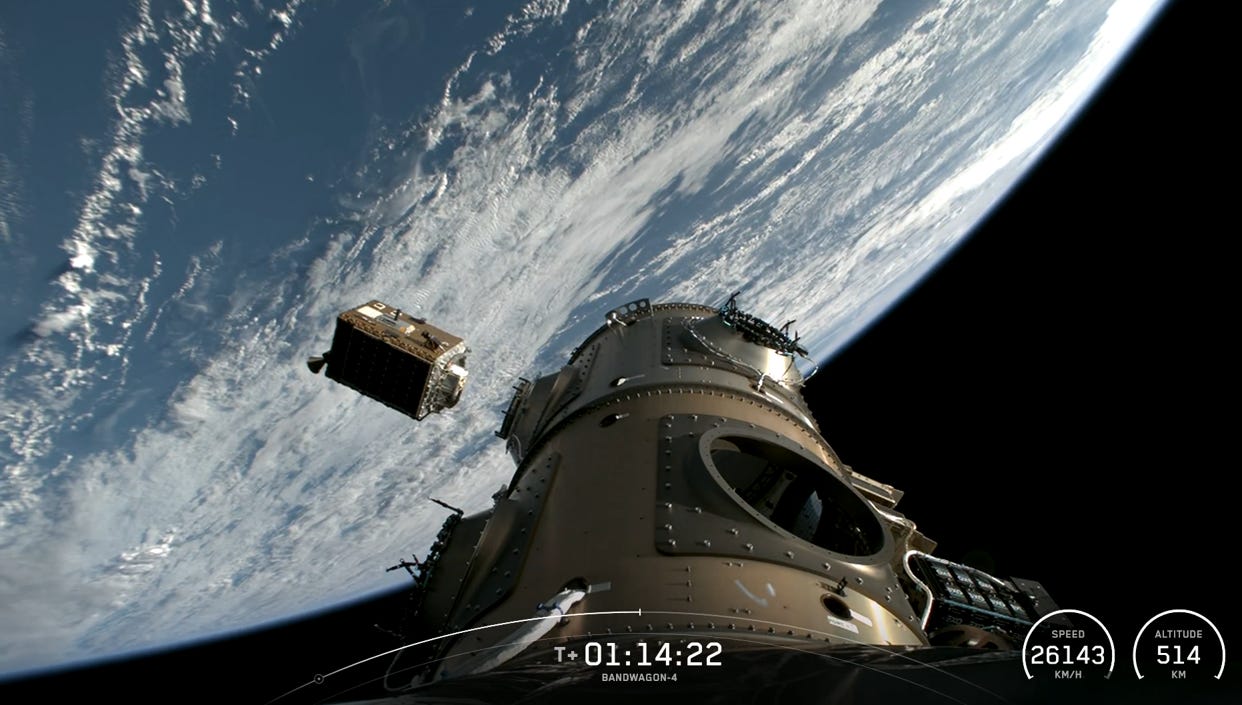
A billion dollars may seem like an astronomical valuation for a Series A company, but only in the sense that it’s an astronautical company. SpaceX raised the bar for pricing space companies when they announced their own ODC efforts at the beginning of the year, merged with xAI, and planned their IPO at over $1T dollars. This is arguably the strongest signal yet that the space industry is entering a new phase, one with more infrastructure and less experiments, where value is being delivered to people on Earth rather than just other companies. Telecommunications continues to be the sector leading the pack in deploying utility around the world, but it is also serving as a harbinger of the potential hurdles remaining for proliferated space applications. Megaconstellations have already launched over 10,000 satellites with hundreds more every month at a rapidly increasing cadence, but to deploy the over 2M spacecraft filed for operation the speed of launch must continue increasing while cost reduces. This is reflected in the massive raises we’ve seen this year with iSpace receiving $729M and Gilmour becoming a unicorn this year with $146M in funding. The other bottleneck is data transmission which we’ve seen being addressed by the exploding optical communication market seeing the acquisition of Bridgecomm, Skyloom, and Mynaric and $100M in funding to Aalyria. Even with faster transmission though, the volume of data required to return to Earth will grow exponentially with data centers in space, and that’s where the first indications of AI’s value has been surfacing. Planet Labs, Loft Orbital, Open Cosmos, and many more have been using AI to reduce the data volumes downlinked to Earth and instead deliver smaller volumes of more valuable insights. While these are different AI’s from the ones Starcloud intends to deploy, they are revealing an important paradigm shift. Data can not only be generated and stored in space, it can also be processed there, reducing the need for the expensive terrestrial networks we’ve grown accustomed to.
5G was an expensive network to deploy, and the cost of data centers on Earth is well understood to be costly in raw materials, regulatory hurdles, and environmental damage. Deploying these capabilities to space removes many of these challenges, but the historical models for cost still suggest it’s prohibitively difficult. The consolation is that we’ve done it before, the ISS generates over 100kW of power, the sort of scale we need for constellations of data centers. The quandary of that correlation is, are we really going to deploy hundreds of ISS? Well no, the ISS was developed three decades ago, to compare the technology we had back then to what’s been developed over the past decade alone is disingenuous. Starcloud-2, launching just 2 years after Starcloud-1 will have 100x the power generation and the largest deployed radiator ever put into space. The solar panels they use will benefit from advances like we’ve seen with Starpath’s Starlite 10x reduction in cost, and Arrina’s technology proposing a further 30% improvement in efficiency. Deployable radiators are a technology that’s been improving on GEOComm satellites for decades including on Viasat-3’s recent deployment and Sierra Space’s testing earlier this year. The GPU’s they are using are advancing as well with Nvidia just last week announcing new chipsets for space including the Vera Rubin which seems tailor made for the application Starcloud is proposing. Providing more inference per watt reduces the challenge of scaling solar panels, and designs for chips that can operate at higher temperatures will likely reduce the radiator challenges by the time Starcloud-3 is ready. With such a large round of funding, and major industry partners in Nvidia Google and AWS, Starcloud is well positioned to address the cost challenges of deploying their 88,000 satellites. In doing so, they also solve the threat to the environment that terrestrial data centers pose, and instead of putting industrial facilities in our backyard they’re putting them in a vast emptiness inhabited by only 10 people. If you want to dig even deeper into the challenges of space data centers, there are a plethora of articles and tools investigating the feasibility; I recommend Andrew McCalip’s tool if you want to better understand all the factors that contribute to the challenge.
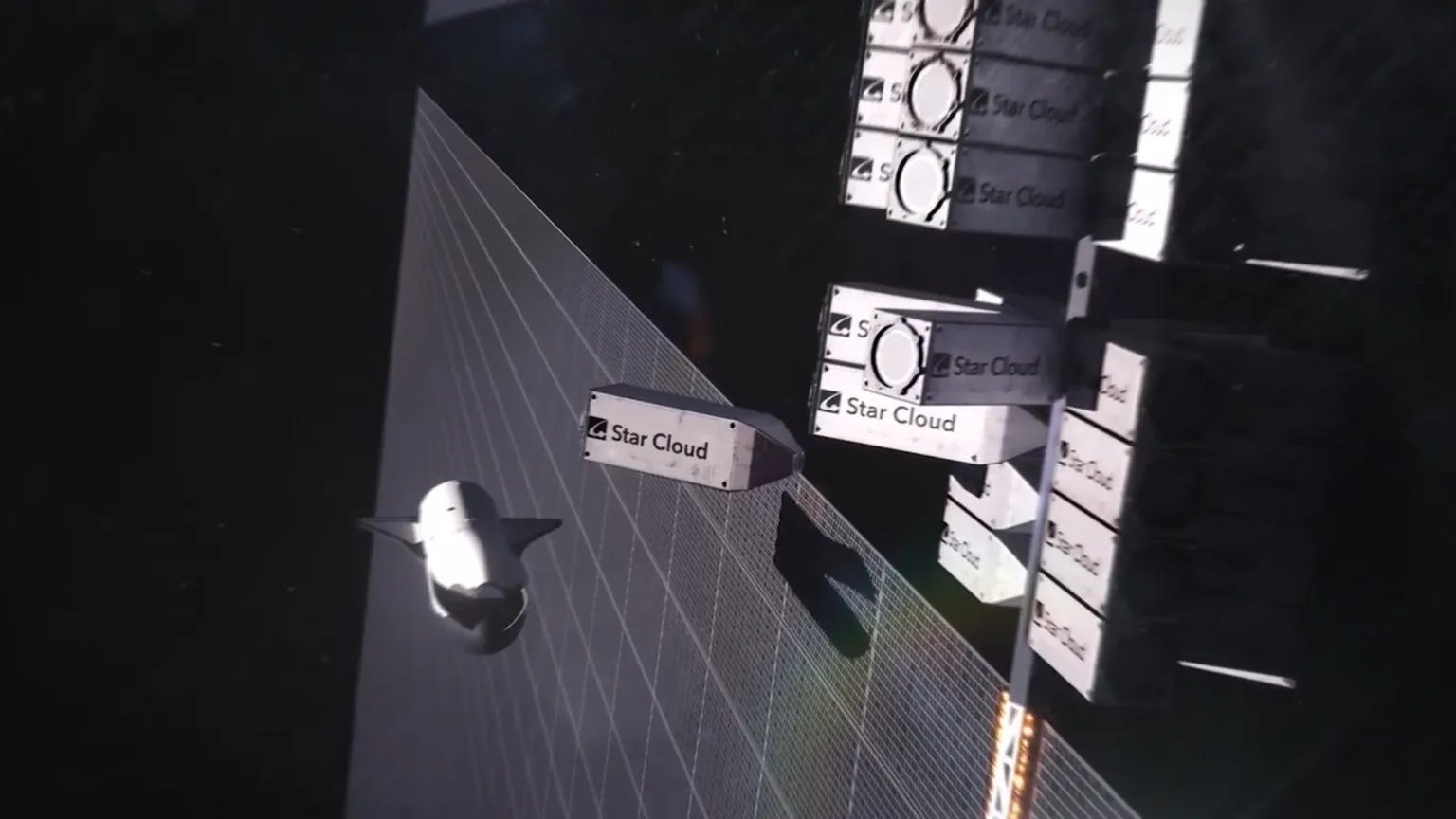
Finally we arrive at the question that plagues much of the space industry, why do we need to solve this problem? As Philip Johnston, CEO of Starcloud, posits “The AI revolution is colliding with the physical limits of our terrestrial energy grid. We are quickly running out of places to build new energy projects for data centers on Earth. By moving AI compute to space, we unlock access to unlimited solar power and completely remove the energy bottleneck.” The argument for putting this in space is similar to that of why we go to space in the first place, to expand beyond the constraints of the Earth. AI is poised to be the largest expansion of human capability since the internet, and the lessons we’ve learned trying to expand the internet across the globe should be evidence enough as to why we need to position this as a space-first technology. In the context of space, the imperative is even broader. We are at the verge of becoming an interplanetary species, Artemis-II is returning humans to the moon, this time to stay. SpaceX is working tirelessly to land Starship on Mars. And China has been pouring billions into their launch and human habitability capabilities to great effect. With these advancements our industry has started asking the next questions, how do we build civilizations on other planets? Laying down wiring and building compute hubs suddenly make less sense than deploying these capabilities into orbit. Earth is our test bed to figure out how to build an interconnected species from space, we will benefit from it here in ways we can predict and others we can’t imagine. The implications, however, are much broader, and Starcloud is at the forefront of figuring it out as a company that has been laser focused on this particular problem for years. They aren’t tied to a dozen different projects like SpaceX, they can launch on any rocket including the heaviest lift New Glenn, and they are partnered with companies that have overtly expressed their interest in building this future like Google and Amazon.
Starcloud has a significant advantage in the orbital data center race having already deployed capability to space, they have the partnerships to build everything they need, and with this funding they have the capital to execute on their ambitions. The industry as a whole has finally accepted ODC’s as a valuable sector to build out, so much so that their Series A was oversubscribed and they’re already preparing for a $500M raise this Fall. 88,000 satellites may seem like a lot, but the sky truly isn’t the limit in this case. Massive orbital compute could be the inciting incident for Kardeshev scale civilization that could expand beyond the reaches of Earth, and Starcloud is ready to find out if that’s the case. If you want to help them build their facilities and satellites, be sure to visit their website.
If you are a space company with exciting news, Space Times would love to talk! Please email contact@spacetimespod.com to discuss how we might provide media coverage for you.
 | A guest post by
|